5 , February
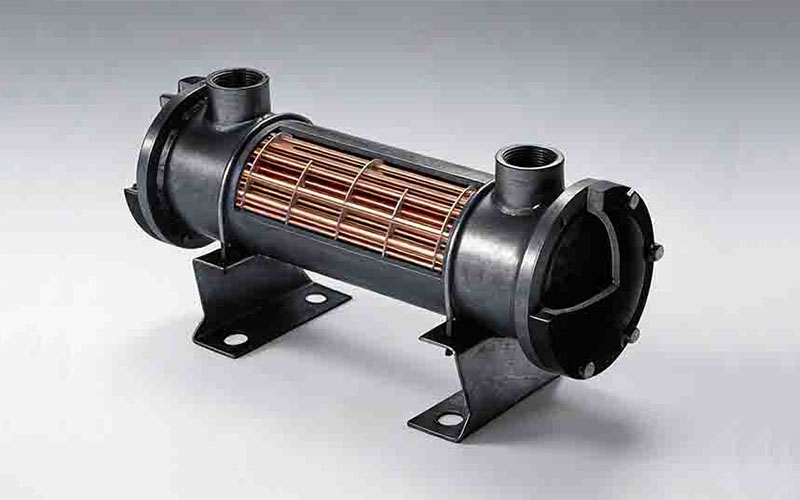
Water Coolers: From Heat Dissipation Tool to Core Engine of System Efficiency
In the wave of precision and digital intelligence in modern industry, the connotation of the fundamental need for “cooling” is undergoing a profound transformation. It is no longer merely about preventing equipment from overheating and failing but has evolved into a core control variable that directly impacts process precision, energy efficiency, and system stability. In this transformation, water coolers, leveraging their unparalleled heat transfer efficiency and precise control capabilities, have ascended from auxiliary equipment to become the “thermal management hub” driving technological upgrades across industries.
I. Fundamental Physical Advantages: Why Water is the Ultimate Medium
Compared to air cooling, the superior performance of water coolers is built upon the fundamental principles of fluid mechanics, representing a qualitative leap:
Exponential Leap in Heat Transfer Efficiency: The specific heat capacity of water is approximately 4 times that of air, and its thermal conductivity is about 25 times greater. This means that, given the same flow rate and temperature differential, water can carry and transfer far more heat than air, enabling more compact units to handle extremely high heat flux densities.
Precise Temperature Control Capability: Water-based systems, by regulating flow rate and inlet water temperature, can achieve precise closed-loop temperature control of the cooled object at levels of ±0.1°C. This level of stability is unattainable with air cooling, which relies on turbulent airflow, providing the essential thermal environment for processes like semiconductor manufacturing and precision chemistry.
Comprehensive Optimization of Energy Efficiency and Noise: Water efficiently transports heat within pipes, with the final heat exchange with the environment occurring at cooling towers or dry coolers requiring only a relatively small air volume. This results in significantly lower overall system energy consumption compared to pure air-cooling systems of equivalent capacity. Furthermore, moving the primary heat source away from sensitive areas drastically reduces noise pollution in the working environment.
II. Core Application Scenarios: Precisely Empowering Cutting-Edge Industries
Water coolers are becoming indispensable infrastructure in multiple strategic emerging sectors:
The Foundation of Computing Power: Data Centers & High-Performance Computing
Challenge: AI training chips and CPU/GPU clusters have broken the kilowatt power barrier, pushing traditional air cooling against the “thermal wall,” with PUE optimization entering a plateau.
Solution: Cold plate liquid cooling directly removes chip heat via microchannel cold plates with extreme efficiency; immersion cooling fully submerges equipment in dielectric coolant, achieving ultimate, silent, and omni-directional heat dissipation. This can reduce data center PUE from the air-cooled baseline of 1.5+ to 1.1-1.2, making it the inevitable choice for future computing centers.
The Eye of Precision: Advanced Manufacturing & Research Equipment
Scenarios: High-power fiber/CO₂ lasers, electron microscopes, vacuum coating machines, particle accelerator magnets.
Value: The temperature stability and purity of the cooling water directly determine beam quality, imaging resolution, and process consistency. Ultra-stable (±0.01°C) ultrapure water cooling systems form the physical foundation enabling these high-end instruments to achieve their design specifications.
The Heart of Energy: Clean Power Generation & Power Electronics
Scenarios: Nuclear power plant main pump bearings, large gas turbine generator sets, VSC-HVDC converter valves, megawatt-scale energy storage inverters.
Value: Provides high-capacity, highly reliable cooling for core power equipment that continuously generates immense heat. Closed-loop water systems prevent environmental contamination, maintaining cleanliness and long-term operational efficiency.
The Pulse of Mobility: New Energy Vehicles & Fuel Cells
Scenarios: Fuel cell stack cooling, high-power fast-charging stations, integrated liquid cooling for drive motors and power modules.
Value: Precise temperature field management is a key technology for improving fuel cell efficiency and lifespan, enabling sustained ultra-fast charging, and ensuring continuous peak power output from electric drive systems.
III. Technology Roadmap: Intelligence & System Integration
The development of next-generation water cooling systems shows clear trends:
Intelligence & Predictive Maintenance: Integrating multi-parameter sensors (flow, temperature, pressure, conductivity) combined with AI algorithms enables real-time system efficiency optimization, leak prediction, and fault forecasting, shifting from “reactive response” to “proactive health management.”
Waste Heat Valorization: Utilizing recovered low-to-medium grade waste heat (30-80°C) from coolant for space heating, process pre-heating, or absorption chilling transforms “waste” into a “resource,” enabling cascade energy use and significantly improving overall energy economics.
Extreme Optimization of Materials & Flow Paths: The use of corrosion-resistant special alloys and high-performance engineering plastics extends service life. Bio-inspired flow path designs based on topology optimization and 3D printing enhance heat exchange efficiency while significantly reducing flow resistance and pumping power consumption.
Conclusion
The water cooler, a system that transfers heat via liquid flow, has seen its technological boundaries expand far beyond traditional “heat dissipation.” It is, in essence, a precision heat transport and management system, a critical piece of infrastructure that enables modern industry to transform disordered waste heat into a controlled and orderly energy flow.
From supporting the computing power of the digital world to enabling the precision manufacturing that shapes the real economy, and further to driving the energy revolution for a green transition, water coolers, in a silent yet highly efficient manner, define the reliable thermodynamic boundaries for breakthroughs in cutting-edge technology. Choosing an advanced water cooling solution means equipping your core system with an efficient, stable, and intelligent “thermal heart,” thereby establishing a solid foundation of performance and efficiency advantage in intense technological competition.